
Virtual home staging and before-and-after images: when to use them in real estate
Virtual home staging and before-and-after images: what they show, when to use them in real estate, when not to, how to prepare them and what to disclose.
By David Dana
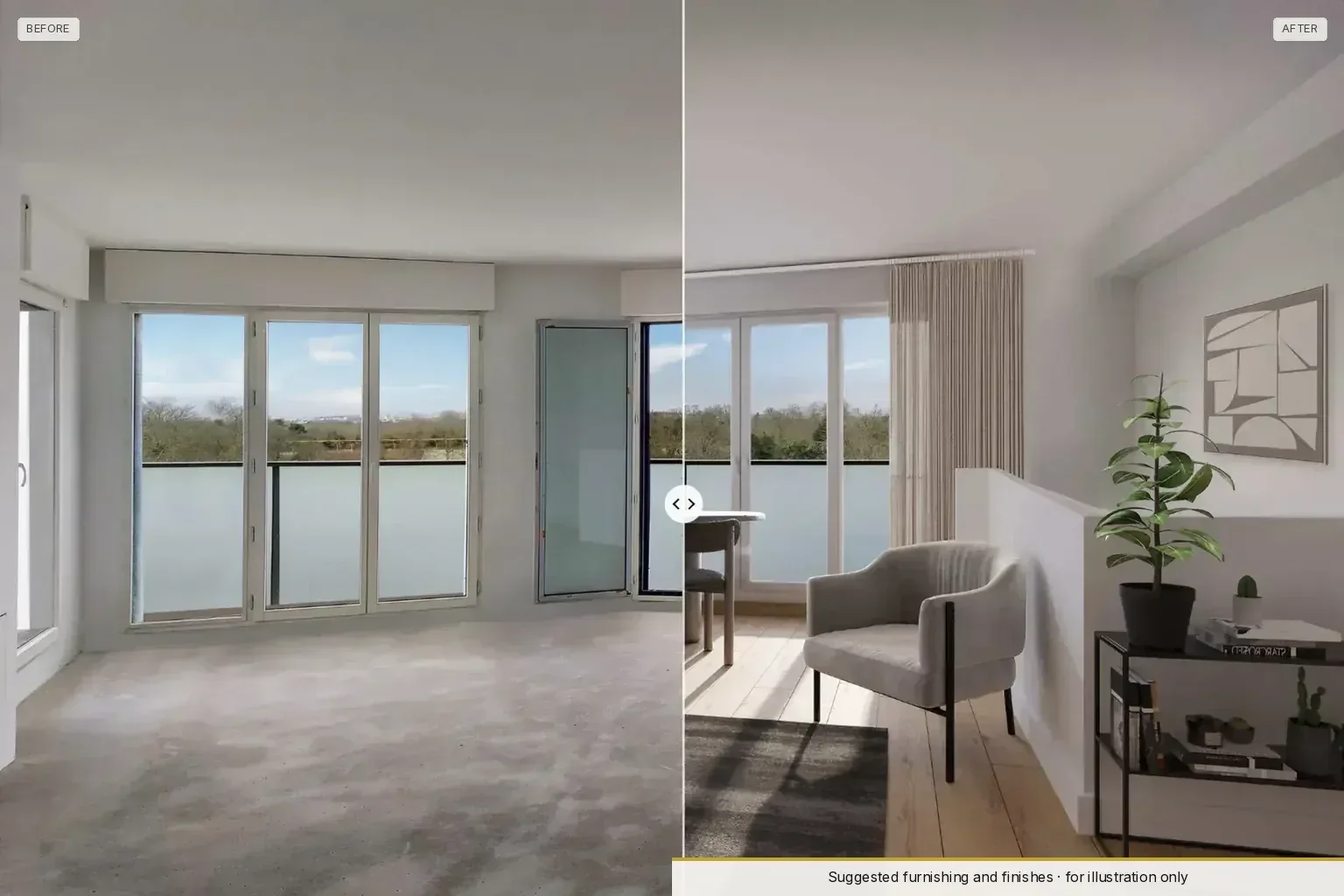
In short: virtual home staging digitally furnishes and decorates the photograph of an existing room, empty or dated, to show how it could be lived in. A before-and-after image places two states side by side in the same framing: the room as it is, then as it could be. Both start from a real photograph. They therefore suit completed homes, properties to renovate and buildings to convert, but not a scheme still sold off-plan, where a 3D rendering takes over.
Most visuals for a new development are produced before ground is broken: renderings, 3D floor plans, a film. Some situations, however, start from something that can be photographed: completed homes still empty at the end of the sales period, an old building to refurbish, offices converted into flats, a courtyard or facade to upgrade. A photograph of an empty room shows walls and a floor, rarely a place to live, and buyers struggle to picture themselves in it.
This article explains what virtual home staging and before-and-after images are, when to use one or the other, when to do without them, how to prepare them and what the image must say to stay fair to the buyer.
Virtual home staging, before-and-after image, 3D rendering: definitions
Virtual home staging furnishes the photograph of a home digitally: furniture, lighting, textiles and decoration are added to the image, in the perspective and light of the original photograph, without moving a single real piece of furniture. The volume, openings and floors remain those of the photograph. Our virtual home staging glossary entry gives the short definition.
A before-and-after image sets two states of the same place side by side, seen from the same viewpoint: the existing space, photographed, and the project, shown in 3D. It is presented as two images side by side or as a slider that viewers drag across a web page. The project may be limited to furnishing (it is then virtual home staging shown with its original photograph) or extend to works: partitions moved, finishes changed, facade restored.
A 3D rendering starts from no photograph at all: the image is entirely computed from the plans, for a building that does not exist yet. It is the tool for schemes sold off-plan.
In short, the starting photograph makes the difference: with no existing space, it is a rendering; with an existing space that is furnished, virtual home staging; with an existing space that is transformed and shown before and after, a before-and-after image.

When to use virtual home staging
New homes handed over empty
At the end of a development, the last units may be finished and still empty. They can be visited, but a photograph of an unfurnished living room is hard to read: buyers cannot tell where the sofa or the table would go, and the room looks smaller or colder than it is. Furnishing that photograph virtually restores a sense of scale and use, without the cost and logistics of real furnishing.
Rooms that are hard to read
An L-shaped living room, a room under the roof, a hallway serving several spaces or a double living room all raise the same question: how would you live here? Furniture placed at the right scale answers better than a description. For exact areas and layout, a 3D floor plan or the dimensioned plan takes over.
An older property, empty or dated
For an older home put on the market empty, or furnished in an unflattering way, virtual home staging offers a current look without works. The rule is the same: only furniture and decoration change, never the condition of the property.
When a before-and-after image works better
A before-and-after image shows the staging together with its original photograph; it comes into its own as soon as the project changes the place itself. It is particularly suited to:
- refurbishment and renovation: showing what a room, a stairwell or a lobby becomes once finishes, partitions or lighting are redone;
- changes of use: offices converted into homes, commercial premises refitted, attics made habitable;
- outdoor spaces: a cleaned facade, a planted courtyard, a redesigned terrace or garden;
- discussions with non-specialists: co-owners, elected officials, neighbours or investors understand the transformation at a glance, because they recognise the starting point.
The comparisons on our before / after visualisation page thus show real renovations: the "after" image adds the furniture and represents the planned finishes.
Showing the existing space next to the project is also a form of transparency: buyers see what is real and what is proposed, rather than discovering the gap during the visit.

When neither is the right choice
- A scheme sold off-plan: there is nothing to photograph. An interior 3D rendering shows the feel of a room, a 3D floor plan its layout; our article 3D floor plan vs 3D rendering helps you choose.
- Hiding a defect: cracks, damp, overlooking, worn equipment. A visual that made it disappear would mislead the buyer.
- Proving feasibility: a projection replaces neither a survey, nor a technical study, nor planning consent for the works.
Situation | Suitable visual | Why |
|---|---|---|
New home handed over empty | Virtual home staging | The photo exists; use and scale are missing |
Room with an unusual shape | Virtual home staging, then 3D floor plan | Furniture shows the use, the plan the areas |
Renovation, refurbishment | Before-and-after image | The starting point and the change must both be seen |
Change of use, outdoor space | Before-and-after image | Viewers already know the original place |
Scheme sold off-plan | 3D rendering, 3D floor plan | Nothing exists yet to photograph |
Preparing virtual home staging or a before-and-after image
The quality of the result depends above all on the starting photograph. A few points to prepare:
- sharp, level photographs, taken at eye level, in daylight, with a lens that distorts little; the room empty and tidy;
- the main dimensions or a plan, so that the added furniture is at the right scale;
- a brief: target audience, style, items to keep, intended materials if works are shown;
- the output format: a still image for a listing or brochure, a before-and-after slider for a web page, versions for social media;
- for a before-and-after image, the same viewpoint for both states, otherwise the comparison loses its impact.
The number of views and the comparison format are then agreed in the quote. To review the images before release, our checklist for approving 3D renderings largely applies.

Transparency: what the image must say
A furnished or transformed image remains a proposal. In France, the consumer authority (DGCCRF) states that a commercial practice is misleading "when it contains false information or information presented in a way that misleads the consumer, or when it omits substantial information" (DGCCRF, misleading commercial practices, in French, consulted 17 November 2026; our translation). A virtually staged photograph should therefore be labelled as such, on the image itself, with a notice such as "suggested furnishing, for illustration only". The added furniture is not sold with the property unless stated otherwise.
For a new home sold off-plan (VEFA), the French housing information agency ANIL adds that "advertising documents have no contractual value": the description annexed to the reservation contract is what counts (ANIL, buying off-plan, in French, consulted 17 November 2026). Our article on the VEFA descriptive notice and 3D renderings explains how visuals relate to these documents.
Choose according to the starting photograph
Virtual home staging answers an existing room that lacks a sense of use; a before-and-after image, a place that is going to change and whose starting point matters; a 3D rendering, a project that exists only on plan. In all three cases, the image helps buyers project themselves, provided it says clearly what it shows.
VIZION STUDIO produces your virtual home staging images and before-and-after comparisons from your photographs, your plans and, where one exists, your 3D model, as still images or interactive sliders. To find out more, see our before / after visualisation page or contact us with a few photographs of the existing space and a short description of the project.
3D services to bring your project to life
Preparing a property launch or an architectural presentation? Explore deliverables and examples relevant to this topic.
Frequently asked questions about virtual home staging and before-and-after images
What is virtual home staging?
It is the digital furnishing of a photograph of an existing room: furniture, lighting and decoration are added to the image, in its perspective and light, without moving any real furniture. The volume, openings and floors remain those of the photograph.
What is the difference between virtual home staging and a before-and-after image?
Virtual home staging furnishes a photograph. A before-and-after image shows two states of the same place in the same framing, the existing space and then the project; it can present simple furnishing or building works. As soon as the project changes the place, a before-and-after image says more.
Can virtual home staging be used for a scheme sold off-plan?
No, because there is nothing to photograph yet. For an off-plan home (VEFA in France), an interior 3D rendering and a 3D floor plan show the atmosphere and the layout of the rooms.
Should a virtually furnished photograph be labelled?
Yes. An image suggesting that the furniture comes with the property could mislead the buyer. A notice such as "suggested furnishing, for illustration only" on each image concerned removes any ambiguity.
Which photographs are needed for virtual home staging?
Sharp, level photographs taken at eye level in daylight, ideally of the empty room, with the main dimensions or a plan so that the furniture stays to scale. For a before-and-after image, the same viewpoint is used for both states.
Give your project the images that will sell it
Tailor-made quote, no commitment.