
Should You Buy Off-Plan (VEFA) in France Today? What Buyers Look At
Fees, guarantees, delays, gaps with the finished home: what off-plan buyers in France check, and the documents and visuals that answer them.
By David Dana
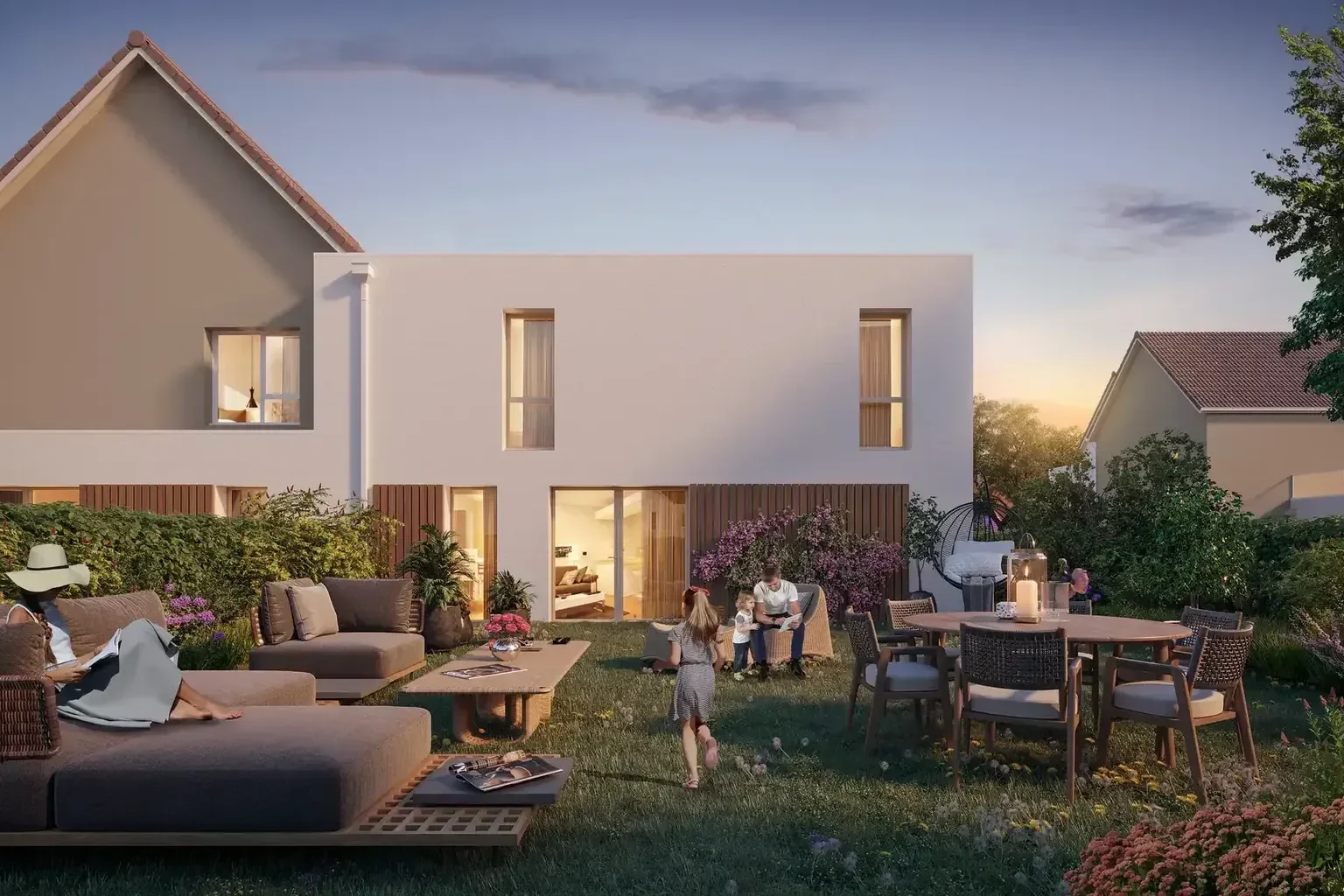
"Should I buy off-plan today?" Many buyers in France ask themselves this question when they hesitate between a new home sold off-plan and an existing property available straight away. A VEFA sale (vente en l'état futur d'achèvement, or off-plan sale) lets a buyer purchase a home before or during its construction, paying for it as the building work progresses. The decision does not rest on a general answer: it depends on concrete criteria such as the total cost, the security of the sums paid, the timetable, the quality of the future home and the ability to picture a property that does not exist yet.
Guides on the subject tend to list the same strengths (lower purchase costs, staged payments, guarantees, homes built to recent standards) and the same drawbacks (price, delays, a possible gap between the project and the finished home). For a property developer, these points are more than sales arguments. They are the questions buyers ask, sometimes at the very first meeting in the sales office.
This article looks at those criteria from the developer's point of view: what the buyer checks, the document that answers each concern and the role of visuals, in particular the virtual tour, in making the project easy to understand. It is not investment advice. For the legal, financial and tax points specific to each situation, the advice of a notary, a lawyer or an adviser remains essential.
Buying off-plan in France: what the buyer actually signs
Before comparing pros and cons, buyers want to understand the process. A VEFA purchase usually takes place in two stages: a reservation contract (contrat de réservation), then the deed of sale (acte de vente) signed before a notary. The guide VEFA off-plan sales in France sets out this framework and the role of each party.
At the reservation stage, ANIL, the French national housing information agency, lists several protections that reassure a hesitant buyer:
- the security deposit (dépôt de garantie) is capped at 5% of the price if the sale is signed within a year, and at 2% if it is signed within one to two years;
- the buyer has a 10-day withdrawal period (délai de rétractation) after receiving the reservation contract;
- the deposit can be refunded in certain cases set by law, for example if the final price exceeds the estimated price by 5% or more.
Then, according to Service Public, the French government information site, the draft deed of sale must be sent to the buyer at least one month before signing. This period is a key moment: it is when the buyer rereads the plans, the descriptive notice (notice descriptive) and the payment schedule, often with their notary. The developer has every interest in making sure that the sales material handed out earlier tells the same story as these documents.
What buyers look at today
A buyer wondering whether to buy off-plan does not only weigh up the market in general. They examine a specific development and a specific unit, and check that each answer is documented. The table below sums up the most common criteria and what the developer can provide.
Criterion | What the buyer checks | What the developer can provide |
|---|---|---|
Total cost | Price of the unit, purchase costs, extras (parking, storage), options | A clear price list, a list of options, a referral to the notary for an estimate of costs |
Payment security | Completion guarantee, schedule of stage payments | Proof of the guarantee, a schedule within the legal caps |
Timetable | Delivery date or period, delay clauses | Provisional schedule, regular progress updates |
The home itself | Floor area, layout, orientation, storage, finishes | Dimensioned plans, descriptive notice, 3D floor plan of the unit, virtual tour |
Surroundings | Neighbourhood, planning rules, risks | Site plan, exterior renderings, risk information |
Performance | Applicable regulations, energy use | Technical information, energy performance certificate |
The table shows one constant: each criterion calls for a written document, and most benefit from a visual that helps the buyer understand what they are reading.
The advantages of buying off-plan, and how to present them
Lower purchase costs
This is often the first argument mentioned. According to Service Public, purchase costs (frais d'acquisition, often called notary fees) for a new home bought off-plan generally amount to about 2 to 3% of the price, compared with about 7 to 8% for an existing home. The developer can present this order of magnitude with its source, while inviting the buyer to ask the notary handling the sale for a precise estimate: the exact amount depends on each transaction.
Staged, regulated payments
The buyer does not pay the whole price at signing. Stage payments (appels de fonds) follow the progress of the works, within cumulative caps set by law and summarised by Service Public:
- 35% of the price when the foundations are complete;
- 70% when the building is weathertight (hors d'eau);
- 95% when the building is complete;
- the remaining 5% at handover (remise des clés), which can be held back (consigné) if defects or non-conformities are recorded as reservations at delivery.
For buyers, this schedule is reassuring as long as they understand it. A simple timeline linking each payment to a visible stage of the works makes the mechanism more concrete than a table of percentages.
Guarantees explained simply
A completion guarantee (garantie financière d'achèvement) is compulsory in a VEFA sale. ANIL states that, for projects whose building permit was applied for from 1 January 2015, only external guarantees, provided by an outside body such as a bank, are allowed. It ensures that the end of the works is financed if the developer defaults.
After acceptance of the works (réception), buyers also benefit from the construction warranties: the one-year completion warranty (garantie de parfait achèvement), the two-year warranty on removable equipment (garantie de bon fonctionnement) and the ten-year structural warranty (garantie décennale), as ANIL and Service Public explain. These periods run from acceptance of the works. The developer should present them clearly, without going beyond what the sources say, and refer buyers to the notary for questions on how they apply.
A home designed to current rules
Buyers also compare the performance of new and existing homes. The French Ministry for the Ecological Transition states that the RE2020 environmental regulation (réglementation environnementale) has applied to the construction of houses and apartment buildings since 1 January 2022. It has three aims: energy efficiency and decarbonised energy, a lower carbon footprint for buildings, and comfort during hot weather. Rather than a general argument, the developer should state which regulation applies to the development and the technical information that follows from it. ANIL also notes that the energy performance certificate (diagnostic de performance énergétique) is given to the buyer at the latest at handover.
Possible state-backed financing, under conditions
Some buyers may qualify for the zero-interest loan (prêt à taux zéro, PTZ) to buy a new home. Service Public explains that it is used to buy or build a main residence, alongside another home loan, and that the borrower must not have owned their main residence in the two previous years. Other conditions apply, and each lender freely assesses the borrower's ability to repay. The developer can mention this option, but checking eligibility is a matter for a broker, a bank or an adviser.

The drawbacks buyers weigh before deciding
Price and waiting time
A new home generally costs more per square metre than a comparable existing property, and the buyer has to wait until the works are finished before moving in. During that period, they may be paying both for their current home and the first instalments of their loan. The developer cannot remove these constraints, but can make them predictable: a clear delivery date, an up-to-date schedule and regular progress updates reduce uncertainty.
Delays remain a common worry. Service Public notes that the contract may include a penalty clause (clause pénale) for late delivery, and that it often contains clauses on legitimate causes of delay, such as bad weather or strikes. Explaining these clauses at the reservation stage avoids an unpleasant surprise later.
The gap between the project and the finished home
This is the drawback most specific to off-plan sales: the buyer cannot visit the home they are buying. ANIL points out that advertising material has no contractual value and that the buyer should refer to the description attached to the contract. It also notes that some contracts include tolerances, notably on floor area, or clauses allowing materials of an "equivalent brand or quality" (marque ou qualité équivalente).
Service Public, for its part, explains that the conformity of the home is assessed against the deed, the plans, the descriptive notice and, in some cases, the sales documents given to the buyer. For the developer, the consequence is simple: a visual should show what the contract documents provide for, and clearly flag what is decoration or an option. The guide VEFA descriptive notice and 3D renderings offers a method to align the two.
Handover and reservations
Handover remains a sensitive step. According to Service Public, the buyer inspects the home and records any observations in a handover report (procès-verbal de livraison), noting reservations (réserves) where necessary; they may be accompanied by a building professional. A buyer who has walked through the home in a virtual tour before handover knows better what to check: the position of the rooms, openings and fittings is already familiar.

Reassuring buyers with visuals: the role of the virtual tour
Faced with a property that does not exist yet, buyers need to picture themselves in it. A 2D plan gives the floor areas, but not everyone can imagine the volumes, the light or the flow between rooms from it. 3D visuals bridge that gap, each with a specific role:
- the 3D floor plan shows the layout of the home and where furniture fits (3D floor plan vs 3D rendering compares the two formats);
- the exterior rendering places the development in its surroundings;
- the virtual tour lets the buyer move through the home room by room, in 360°, and get a sense of volumes and views.
The virtual tour responds directly to the "you can't visit it" drawback. The buyer goes from the living room to the terrace, looks at the openings, returns to a room. For a developer, it works in the sales office, in remote appointments and on the development's web page. The guide briefing a property virtual tour explains how to plan the route through the home.
For a virtual tour to reassure buyers rather than raise new questions, a few rules apply:
- Choose representative units: the most requested types, or those whose layout is hardest to read on a plan.
- Work from the latest plans: the tour must reflect the latest revision of the plans, with the right dimensions and openings.
- Show the finishes in the notice: floors, joinery and fittings delivered must match the specification; options are flagged as such.
- Separate what is delivered from what is suggested: furniture and decoration illustrate a use, which a clear notice should state.
- Link the tour to the documents: hotspots can point to the unit plan or a section of the notice.
- Update after every change: a change of plan or finish should trigger a review of the tour before it is shared again.

Preparing answers before the meeting
A hesitant buyer rarely asks just one question. Developers save time, and gain credibility, by putting together a complete file for each development in advance:
- proof of the completion guarantee;
- the descriptive notice and dimensioned plans of each unit;
- the schedule of stage payments and the provisional timetable;
- planning information and the statement of risks and pollution (état des risques et pollutions), which ANIL says is attached to the reservation contract;
- technical information on the building's performance;
- up-to-date visuals: renderings, 3D floor plans, virtual tour, with their date and the plan revision used;
- the template reservation contract, for the buyer to review with their notary.
ANIL also suggests that buyers visit the area to judge the neighbourhood, amenities and transport, compare the prices and specifications of several developers and, where possible, visit other developments built by the same developer. A developer who anticipates these steps, for example by presenting previous projects, turns a concern into a strength.
So, should you buy off-plan today?
There is no universal answer. Buying off-plan may suit a buyer who wants a new home, accepts a wait before moving in and wishes to benefit from lower purchase costs and staged payments. Another buyer will prefer an existing property available immediately. The decision depends on the project, the budget, personal circumstances and the development itself, and deserves the advice of a notary, a lawyer or an adviser.
For the developer, the challenge lies elsewhere: enabling each buyer to decide with full knowledge of the facts. Clear documents, sourced answers and visuals faithful to the plans and the notice make the project understandable, and a well-informed decision also makes for a smoother sale.
To help buyers picture themselves in an off-plan development, VIZION STUDIO produces 360° virtual tours of new homes, crafted by hand by the team in 3D software. The team can start from the project's 3D model or from the plans supplied by the developer, using the descriptive notice to show the specified finishes. Discover the Virtual tour service and request a custom quote for your development.
3D services to bring your project to life
Preparing a property launch or an architectural presentation? Explore deliverables and examples relevant to this topic.
Frequently asked questions about buying off-plan in France
Should you buy off-plan (VEFA) now or wait?
There is no answer that suits everyone. Buying off-plan may suit a buyer who wants a new home and accepts a wait before moving in. The decision depends on the budget, personal circumstances and the development itself: a notary, a lawyer or an adviser can help assess it.
What are the notary fees for an off-plan purchase in France?
According to Service Public, purchase costs (frais d'acquisition) for a new home bought off-plan generally amount to about 2 to 3% of the price, compared with about 7 to 8% for an existing home. The notary handling the sale can give a precise estimate for each transaction.
When do you pay for a home bought off-plan?
The price is paid as the works progress. Service Public sets out the cumulative caps: 35% when the foundations are complete, 70% when the building is weathertight, 95% when it is complete, and the balance at handover. This balance can be held back if reservations are recorded at delivery.
Is a virtual tour contractually binding?
ANIL points out that advertising material has no contractual value: the deed, the plans and the descriptive notice (notice descriptive) are the reference. Service Public adds that conformity may also be assessed, in some cases, against the sales documents. Hence the value of visuals that match the contract documents.
How do you request a quote for a virtual tour of an off-plan development?
Simply send the latest plans or the project's 3D model, the descriptive notice and the list of homes to present through the Virtual tour page of the website. The team reviews these documents and sends a custom quote tailored to the development.
Give your project the images that will sell it
Get your first 3D image within 72 hours. Custom quote, no commitment.